
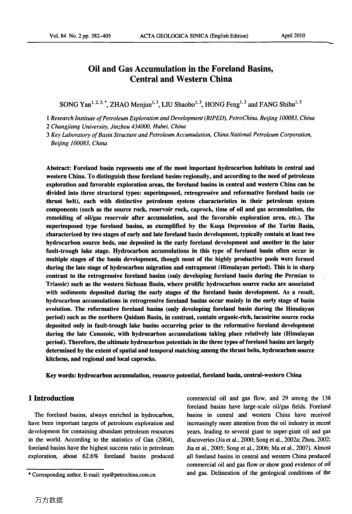
Foreland basin represents one of the most important hydrocarbon habitats in central and western China.To distinguish these foreland basins regionally,and according to the need of petroleum exploration and favorable exploration areas,the foreland basins in central and western China can be divided into three structural types: superimposed,retrogressive and reformative foreland basin (or thrust belt),each with distinctive petroleum system characteristics in their petroleum system components (such as the source rock,reservoir rock,caprock,time of oil and gas accumulation,the remolding of oil/gas reservoir after accumulation,and the favorable exploration area,etc.).The superimposed type foreland basins,as exemplified by the Kuqa Depression of the Tarim Basin,characterized by two stages of early and late foreland basin development,typically contain at least two hydrocarbon source beds,one deposited in the early foreland development and another in the later fault-trough lake stage.Hydrocarbon accumulations in this type of foreland basin often occur in multiple stages of the basin development,though most of the highly productive pools were formed during the late stage of hydrocarbon migration and entrapment (Himalayan period).This is in sharp contrast to the retrogressive foreland basins (only developing foreland basin during the Permian to Triassic) such as the western Sichuan Basin,where prolific hydrocarbon source rocks are associated with sediments deposited during the early stages of the foreland basin development.As a result,hydrocarbon accumulations in retrogressive foreland basins occur mainly in the early stage of basin evolution.The reformative foreland basins (only developing foreland basin during the Himalayan period) such as the northern Qaidam Basin,in contrast,contain organic-rich,lacustrine source rocks deposited only in fault-trough lake basins occurring prior to the reformative foreland development during the late Cenozoic,with hydrocarbon accumulations taking place relatively late (Himalayan period).Therefore,the ultimate hydrocarbon potentials in the three types of foreland basins are largely determined by the extent of spatial and temporal matching among the thrust belts,hydrocarbon source kitchens,and regional and local caprocks.

-
C4烯烴制丙烯催化劑 2023-02-01
-
煤基聚乙醇酸技術(shù)進(jìn)展 2023-02-01
-
生物質(zhì)能的應(yīng)用工程 2023-02-01
-
我國(guó)甲醇工業(yè)現(xiàn)狀 2023-02-01
-
四噴嘴水煤漿氣化爐工業(yè)應(yīng)用情況簡(jiǎn)介 2023-02-01
-
Lurgi和ICI低壓甲醇合成工藝比較 2023-02-01
-
甲醇制芳烴研究進(jìn)展 2023-02-01
-
精甲醇及MTO級(jí)甲醇精餾工藝技術(shù)進(jìn)展 2023-02-01