
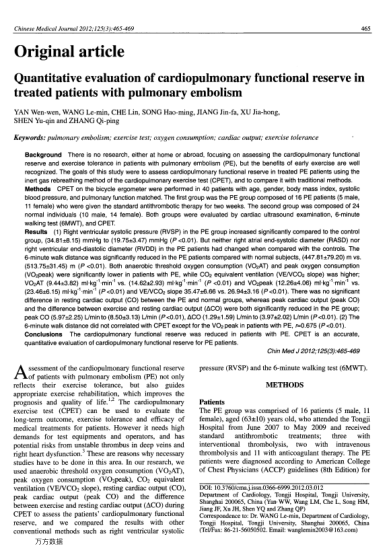
Background There is no research,either at home or abroad,focusing on assessing the cardiopulmonary functional reserve and exercise tolerance in patients with pulmonary embolism (PE),but the benefits of early exercise are well recognized.The goals of this study were to assess cardiopulmonary functional reserve in treated PE patients using the inert gas rebreathing method of the cardiopulmonary exercise test (CPET),and to compare it with traditional methods.Methods CPET on the bicycle ergometer were performed in 40 patients with age,gender,body mass index,systolic blood pressure,and pulmonary function matched.The first group was the PE group composed of 16 PE patients (5 male,11 female) who were given the standard antithrombotic therapy for two weeks.The second group was composed of 24 normal individuals (10 male,14 female).Both groups were evaluated by cardiac ultrasound examination,6-minute walking test (6MVVT),and CPET.Results (1) Right ventricular systolic pressure (RVSP) in the PE group increased significantly compared to the control group,(34.81±8.15) mmHg to (19.75±3.47) mmHg (P <0.01).But neither right atrial end-systolic diameter (RASD) nor right ventricular end-diastolic diameter (RVDD) in the PE patients had changed when compared with the controls.The 6-minute walk distance was significantly reduced in the PE patients compared with normal subjects,(447.81±79.20) m vs.(513.75±31.45) m (P <0.01).Both anaerobic threshold oxygen consumption (VO2AT) and peak oxygen consumption (VO2peak) were significantly lower in patients with PE,while CO2 equivalent ventilation (VE/VCO2 slope) was higher;VO2AT (9.44±3.82) ml·kg1.min-1 vs.(14.62±2.93) ml.kg-1.min-1 (P <0.01) and VO2peak (12.26±4.06) ml.kg-1.min-1 vs.(23.46±6.15) ml.kg-1.min-1 (P <0.01) and VE/VCO2 slope 35.47±6.66 vs.26.94±3.16 (P <0.01).There was no significant difference in resting cardiac output (CO) between the PE and normal groups,whereas peak cardiac output (peak CO)and the difference between exercise and resting cardiac output (ACO) were both significantly reduced in the PE group;peak CO (5.97±2.25) L/min to (8.50±3.13) L/min (P<0.01),ACO (1.29±1.59) L/min to (3.97±2.02) L/min (P<0.01).(2) The 6-minute walk distance did not correlated with CPET except for the VO2 peak in patients with PE,r=0.675 (P <0.01).Conclusions The cardiopulmonary functional reserve was reduced in patients with PE.CPET is an accurate,quantitative evaluation of cardiopulmonary functional reserve for PE patients.

-
C4烯烴制丙烯催化劑 2023-04-18
-
煤基聚乙醇酸技術(shù)進(jìn)展 2023-04-18
-
生物質(zhì)能的應(yīng)用工程 2023-04-18
-
我國(guó)甲醇工業(yè)現(xiàn)狀 2023-04-18
-
四噴嘴水煤漿氣化爐工業(yè)應(yīng)用情況簡(jiǎn)介 2023-04-18
-
Lurgi和ICI低壓甲醇合成工藝比較 2023-04-18
-
甲醇制芳烴研究進(jìn)展 2023-04-18
-
精甲醇及MTO級(jí)甲醇精餾工藝技術(shù)進(jìn)展 2023-04-18